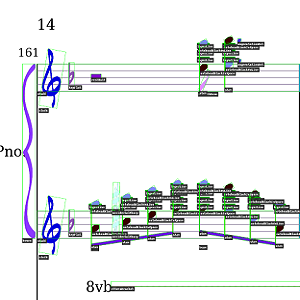
RealScore. ScorePad’s sheet-music scanning service worked well on high-quality input. That is a narrow business: real customers photograph used sheets on a phone, under bad light, on paper that has been folded, annotated in pencil and left in a case for twenty years.
RealScore set out to close that gap by making the deep learning adapt to data it had never seen, without anyone labelling it.
What worked
- Augmentation that simulates the real world. Combining synthetic data with noisy perturbations of genuine documents, ageing, lighting, dirt, narrowed the distance between the sanitised benchmark and the actual task. Detection performance on noisy real-world data went from 36.0 to 73.3 per cent.
- Adversarial domain adaptation. Unsupervised, and worth 12.9 points on its own, taking the 36.0 baseline to 48.9 without any target labels.
- Confidence you can act on. Model ensembles with prediction fusion produce a trustworthy rating per prediction, which is what makes human post-processing efficient rather than a second full pass.
Evaluated on a new test set of manually annotated pages of varying real-world quality, sourced from IMSLP, the Petrucci Music Library. Published in TISMIR.